

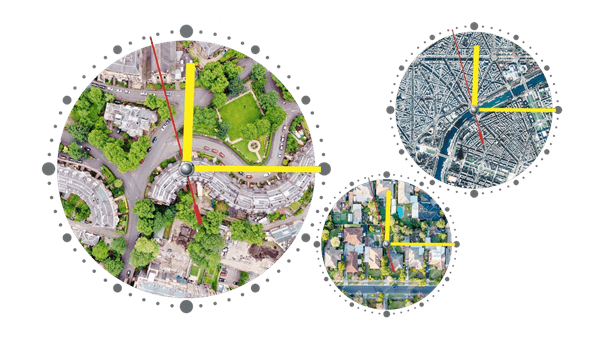
The 15-Minute City: Rethinking Urban Accessibility
The 15-minute city is an urban planning concept that reimagines how cities are designed and experienced. At its core, the idea proposes that most daily needs—such as work, education, healthcare, shopping, recreation, and social interaction—should be accessible within a 15-minute walk or bicycle ride from where people live. By organizing cities around proximity and accessibility, the concept aims to reduce long commutes, strengthen local communities, and improve overall quality of life.
Defining the Concept
A 15-minute city can be described as an ideal urban geography where residents can meet the majority of their daily needs within a short travel distance. This model prioritizes human-centered urban design, encouraging walking, cycling, and accessible public transportation instead of reliance on private vehicles.
The approach also supports broader goals such as:
-
Reduced traffic congestion and pollution
-
More vibrant local economies
-
Stronger community connections
-
Healthier lifestyles through active mobility
-
Greater environmental sustainability
In essence, the 15-minute city promotes compact, connected, and multifunctional urban environments where essential services are integrated into local areas.
15-Minute Neighborhood vs. 15-Minute City
There is often confusion between the terms “15-minute neighborhood” and “15-minute city.” Although they share the same general intention—improving proximity to essential services—the two concepts differ in scale.
A 15-minute neighborhood focuses on a single local area, ensuring that residents within that neighborhood can access daily necessities within a short walking or cycling distance.
A 15-minute city, however, represents a city-wide urban planning strategy. Instead of improving accessibility in just one neighborhood, the entire urban system is designed so that multiple interconnected neighborhoods collectively provide access to all essential services.
Therefore, the concept of the 15-minute city goes far beyond a single neighborhood, emphasizing the transformation of the whole urban ecosystem.
Global Examples of the Concept
Several cities around the world have adopted similar accessibility-oriented planning models, adapting the concept to their local contexts.
Melbourne – 20-Minute Neighborhoods


The city of Melbourne introduced a long-term strategic planning framework centered on “20-minute neighborhoods.” The goal is to ensure that residents can reach most daily services—such as shops, schools, parks, and public transport—within a 20-minute walk from home. This initiative supports local economic activity while promoting walkability and reducing car dependency.
Detroit – 20-Minute City Concept


Detroit has explored a 20-minute city concept that builds upon the structure of its historic streetcar grid. By revitalizing neighborhoods around this legacy infrastructure, the city aims to encourage mixed-use development and improve access to essential services within short travel distances.
Ottawa – 15-Minute Neighborhood Plan


Ottawa has introduced a 15-minute neighborhood strategy designed to shift travel patterns toward sustainable mobility. The city aims for residents to complete approximately half of their daily trips by walking, cycling, public transit, or carpooling. The initiative focuses on improving access to schools, parks, services, and employment opportunities within local communities.
Toward More Human-Centered Cities
The growing interest in the 15-minute city reflects a broader shift in urban planning toward people-centered design. Rather than structuring cities around long-distance commuting and automobile dependency, this model emphasizes proximity, accessibility, and community life.
By integrating housing, workspaces, services, and recreation within short distances, the 15-minute city has the potential to create more sustainable, inclusive, and resilient urban environments—where daily life becomes simpler, healthier, and more connected.